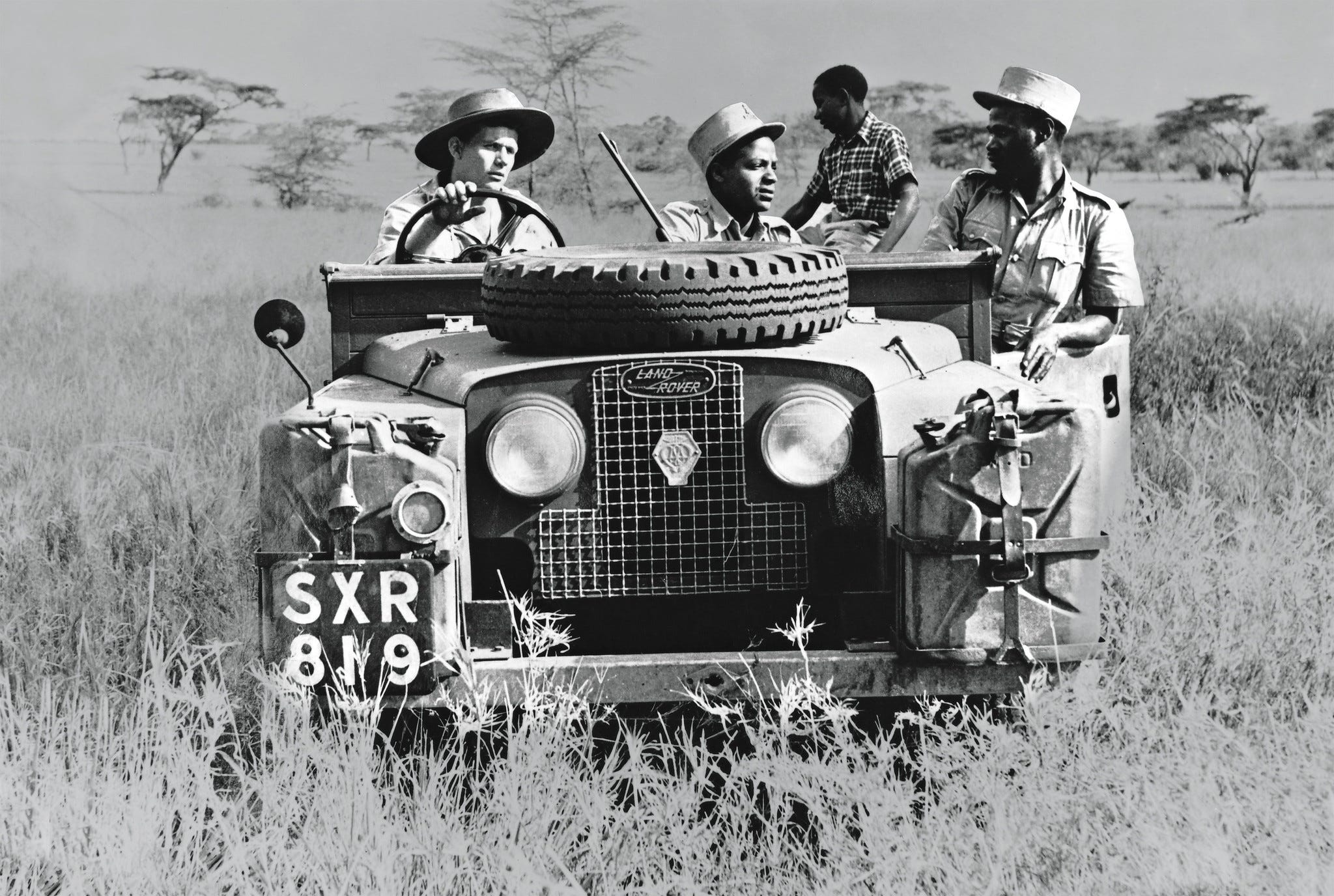
How did the world’s most famous 4×4 maker manage to survive its rollercoaster ride through history? asks Dave Phillips

HISTORY would have turned out very differently if, one fateful night in July 1888, Klara Hitler had told her hubby Alois that she’d got a headache and would prefer to go to sleep. The world without Adolf Hitler would have been a very different place. Better? To most, definitely. But perhaps not to me, personally. Without the Second World War, my father, an airman, wouldn’t have been stationed in Norfolk and met my mother. And that means somebody else would now be writing this.
Only it doesn’t. Without the war, America wouldn’t have sent hundreds of thousands of Jeeps to Europe, which means that immediately after the war Maurice Wilks wouldn’t have ended up with an army-surplus Jeep on his farm in Anglesey. And if Maurice hadn’t had a Jeep, what would he have done when his elder brother (and Rover managing director) Spencer came to visit? Would the two have still gone to Red Wharf Bay? And if they did, would they have built sandcastles instead of (**allegedly) sketching prototype Land Rovers in the sand?
Without their decision to build that prototype there would have been no Land Rovers. And if there were no Land Rovers, there wouldn’t be much point in writing this blog.
The world is full of accidents of fate. If an unseasonal gale hadn’t blown up in the summer of 1588, the Spanish Armada may have successfully invaded England and we’d be sitting around now nibbling tapas and looking forward to the weekend’s bullfight. But that’s only assuming we hadn’t won the Battle of Waterloo in 1815. If we’d lost that one, we’d all be French now. And don’t forget the 1914-18 war, when another bunch of Germans got all aggressive.
But let’s be more Land Rover-specific. The fickle finger of fate has certainly played its part over the years since 1947, when the Wilks brothers (**allegedly) drew those pictures in the sand. Come to think of it, would the Land Rover have even got off the ground if they hadn’t been siblings? If anyone other than his kid brother had drawn a crude picture of a car in the sand and suggested putting it into production, do you think Rover’s managing director would have agreed?

Even if he had reluctantly given the green light, what would have been his reaction when it turned out the first prototype had its steering wheel in the middle? He would have decided that was the end of that barmy scheme, I reckon.
Yet, as we all know, the Wilks brothers’ creation was a runaway success.
But it wasn’t all plain sailing for the next 68 years. What would have happened if the world hadn’t been ready for the Range Rover in 1970? Would the cash-strapped marque have survived if it hadn’t launched the best-selling Discovery in 1989? And would the Defender itself have survived from 1990 onwards if it hadn’t been able to make use of the new technology — most notably the Tdi and Td5 engines — designed with mainly the Discovery in mind?
Then there’s the little matter of ownership. How did Land Rover survive its 20 years as part of the monolithic and self-destructing British Leyland empire, while once-great names like Austin, Morris, Wolseley, Triumph and Riley quietly faded away?
Where would Land Rover be today if the company hadn’t been sold by BWM to Ford, in 2000? Would there be a smaller range, of high-end models? And if Ford hadn’t sold Land Rover off to Tata in 2008, would later Land Rover models now be powered by the most suitable engines from the Ford range, rather than enjoying Ingenium engines from their own factory?
When you look back on Land Rover’s turbulent history, you can’t help concluding that it’s a lucky company. Every time it reached a fork in the road, it somehow managed to take the right turn. I can’t think of any major turning point where Land Rover didn’t head in the best direction.
But I reckon the most significant period of all has to be immediately after the Second World War. Tata was founded in 1945 and was destined to flourish under Indian independence, granted in 1947 — the same year that those lines were (**allegedly) drawn in the sand.
The evil spawned unwittingly by Herr und Frau Hitler changed the world for the worse. But it gave the good the chance to conquer evil, and the positive conclusion of that conflict eventually gave us the greatest vehicles in the world. Let’s just call it fate.
** Why do I keep putting “allegedly” in brackets every time I mention the sketch in the sand? Because it never happened; it was invented by Land Rover’s marketing department long after the supposed event.
Leave a Reply