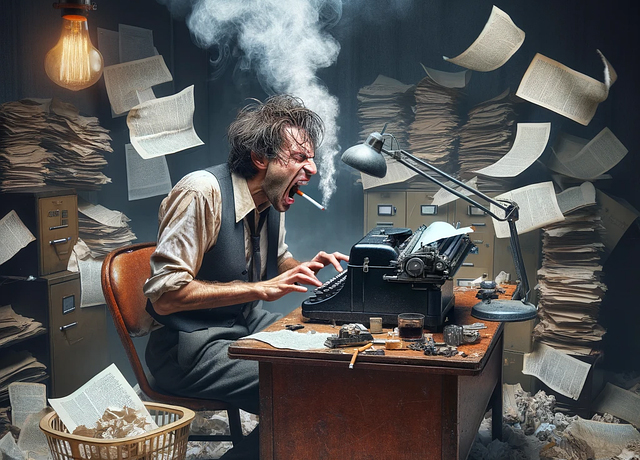
Part 2 of writer Dave Phillips’ special report on the decline of the newspaper and magazine publishing industry
LAST year, in a Substack post, I explained why, after a long career as a journalist, I had decided to concentrate on book publishing. This is what I wrote:
If I’d known in the 1980s and ‘90s that I was working as a journalist in a golden age for my industry, I’d have toiled harder and spent less time in the pub. Probably — but unlikely. For starters, I’d have led a very lonely existence, with all my colleagues in the bar, knocking them back.
Besides, alcohol was a good anaesthetic for the shock that was just around the corner.
I should have seen it coming. Back in 1975, I was a teenage reporter on the Cambridgeshire Times when the proprietors, Sharmans, introduced computer technology to replace their human typesetters. The print union, the NGA, went on strike, but the company’s NUJ chapel refused to back them. It caused a stink at the time, and one senior journalist on the Wisbech Standard, who had just been offered a job on the Birmingham Post, saw his offer withdrawn when the Post’s NUJ chapel refused to work with a “blackleg”.
Computers could mean trouble, all right, especially when technology replaced human skills. The 1980s saw Fleet Street transformed, and under Thatcher, the once-powerful print unions were slaughtered, but as journalists, we were all right, yeah? After all, no computer could recreate our unique skills, we thought.
As the new millennium approached, journalists fell in love with computers. Word processing made copywriting and editing easy, while the internet was the best research tool ever. Better still, email changed the way we communicated. We’d never had it so good.
Or had we? By 2000, ad revenues were crashing, followed by circulation figures. Advertisers found it cheaper to set up their own websites than to buy expensive page space. Meanwhile, a new generation of readers preferred to grab their news and entertainment on screen rather than in print. It’s a trend that has only got worse over the past quarter-century.
That’s a brief outline of the causes. Brevity is the trademark of the good sub-editor, but I feel uncomfortable skimming over so much social history in six short paragraphs. So let’s dive in deeper . . .
The 1975 Sharmans incident I mentioned above was infamous at the time. The family-owned company, which ran half a dozen or so weekly titles in Peterborough and northern Cambridgeshire, installed OCR (optical character recognition) systems at its production facility at Fengate, Peterborough. This enabled copy typed by journalists to be converted into editable text without being re-typed by typesetters at the works. The typesetters faced redundancy. Their union, the NGA (National Graphical Association), called a strike and requested the NUJ to do the same. The NUJ narrowly voted against strike action, and management pressed the new equipment into service. After some initial hiccups, it worked more or less flawlessly. New technology had defeated the NGA, one of the most powerful unions.
A decade later, Rupert Murdoch pulled a similar stunt on a much more audacious scale when he sacked 5,500 print workers and moved his News International newspapers — the Sun, the News of the World, the Times and the Sunday Times — from Fleet Street to a new plant at Wapping. This time, journalists worked from terminals connected to a state-of-the-art computer system, entering text directly into it, which was manned by the electricians’ union. The so-called Battle of Wapping of 1986-87 followed — a year-long, violent industrial conflict.

Every night, hundreds of trade unionists and left-wing activists flooded into the streets around Wapping in an attempt to prevent trucks full of newly-printed newspapers from leaving the plant. But they stood no chance. This was at the height of Margaret Thatcher’s reign as Prime Minister. She was obsessively anti-union and was happy to meet the overtime payments of hundreds of policemen into the nightly melee. There were over 1,200 arrests, but the papers got through. It broke the power of the British print unionists and was a decisive victory for management. The rest of Fleet Street soon followed, as well as provincial newspapers across the land.
By the time I arrived as chief sub of the Northampton Chronicle & Echo evening paper in 1989, was owned by United Newspapers, which also owned the Daily Express, Sunday Express and Daily Star, as well as regional papers like the Yorkshire Post. ‘The Chron’, as it was known locally, employed the same computer system as News International and had staffed its composing room with a new team of all-female paste-up recruits. It worked flawlessly, which was a bonus for me. I was in charge of the team of sub-editors producing three editions a day, six days a week. I can honestly say it was the best workplace I’d ever worked in — surrounded by talented and hard-working fellow journos who loved what they did.
This was genuinely a golden age for newspaper and magazine publishing. The economy was booming — this was the Loadsamony era — and advertising was hugely lucrative, especially in the magazine world. I don’t think a day passed without yet another consumer magazine being published: the more specialised the subject, the better. That’s because specialist magazines attracted mail-order advertising in those pre-Internet days. When I joined the monthly Land Rover Owner magazine in 1997, a typical issue was well over 200 pages — more than half of which was advertising. One advertiser who sold Land Rover parts by mail order regularly took out 14 pages of ads per issue. The page rate was £1,000 a page, so work it out for yourselves.

That sort of cash sloshing around meant editorial budgets were generous. I joined LRO as production editor (fancy name for chief sub), was quickly promoted to deputy editor and was made editor in 2000. During that period, I spent, on average, one week a month abroad, driving Land Rovers off-road through some amazing places. It included driving Australia’s Simpson Desert, Botswana’s Okavango Delta, and the Malaysian rainforest. I even spent a week in Barbados. And got paid for it.
It seemed too good to be true — and it was. In the new century, advertising revenues took a hit as mail-order specialists set up their own websites and sold directly to customers. Their advertising spend slowly dropped, as more people got hooked up to the internet. By around 2010, most mail-order advertising had evaporated. That meant magazines shrank in size, making them less attractive to readers, many of whom were also turning to the internet for their reading matter.
One of the first genres of magazines at Emap to suffer were the boy-racer mags like Max Power, which featured hot hatches and even hotter young females. Its young journalists used to kid themselves that their writings on fast cars were responsible for the big circulation figures, when in fact much of the mag’s popularity was down to teenage boys, who were actually seeking soft porn. They could openly buy a car mag and sneak it past their parents, who were blissfully unaware of its contents. This was the Jordan era, and her twin assets featured regularly — she was even ‘guest editor’ of the magazine for one issue.
But once porn became freely available online, the, er, bottom dropped out of the market. Lads’ mags were among the first casualties. Once magazines became unprofitable, publishing companies had no problem closing them as quickly as they had launched them, just a decade earlier.
Back in June 1996, Emap — the company I’d joined as an indentured trainee journalist in 1972 — had sold its regional newspapers and printing businesses to Johnston Press for £205 million. And a year after I left Land Rover Owner magazine to go freelance in 2006, its consumer magazines were sold to H Bauer. Land Rover Owner itself ceased publishing in 2023 — what a sad ending for a magazine that was making well over £1 million profit a year at the turn of the century.
Perhaps we took the golden era of newspapers and magazines for granted, but the floodtide of technology was — and still is — inevitable. Computers made journalists’ jobs easier at first, but have come back to bite us. Meanwhile, the small, family-owned publishing companies were swallowed up by bigger publishers who unsentimentally spat them out again. If AI can replace a human journalist, the bean-counters will ditch the journo every time.
I’m trying desperately to put a positive spin on this, but I’m struggling. Everyone in the industry knows that the average age of newspaper and magazine readers is getting higher every year. It’s mainly because my generation can’t kick the habit that they’re even surviving. With a world of information and entertainment literally at their fingertips with a swipe of their phone, the young simply don’t need them.
The slow drip-drip of lesser-known magazines and local papers folding is one thing, but expect some shock waves when the big national papers start to tumble. We all know that some of them are already so feeble that being put out of their misery could be seen as an act of mercy.
If it’s any consolation, workers in other industries are in the same position as journalists. AI is being trained to replace just about everyone. For example, I’ve no doubt that bosses at the NHS are looking forward to the day when AI can replace those pesky resident doctors that keep going on strike.
And just think: if we could scrap the Royal Family and have AI as head of state, there’d be no more problems with the Andrew formerly known as Prince.


Leave a Reply