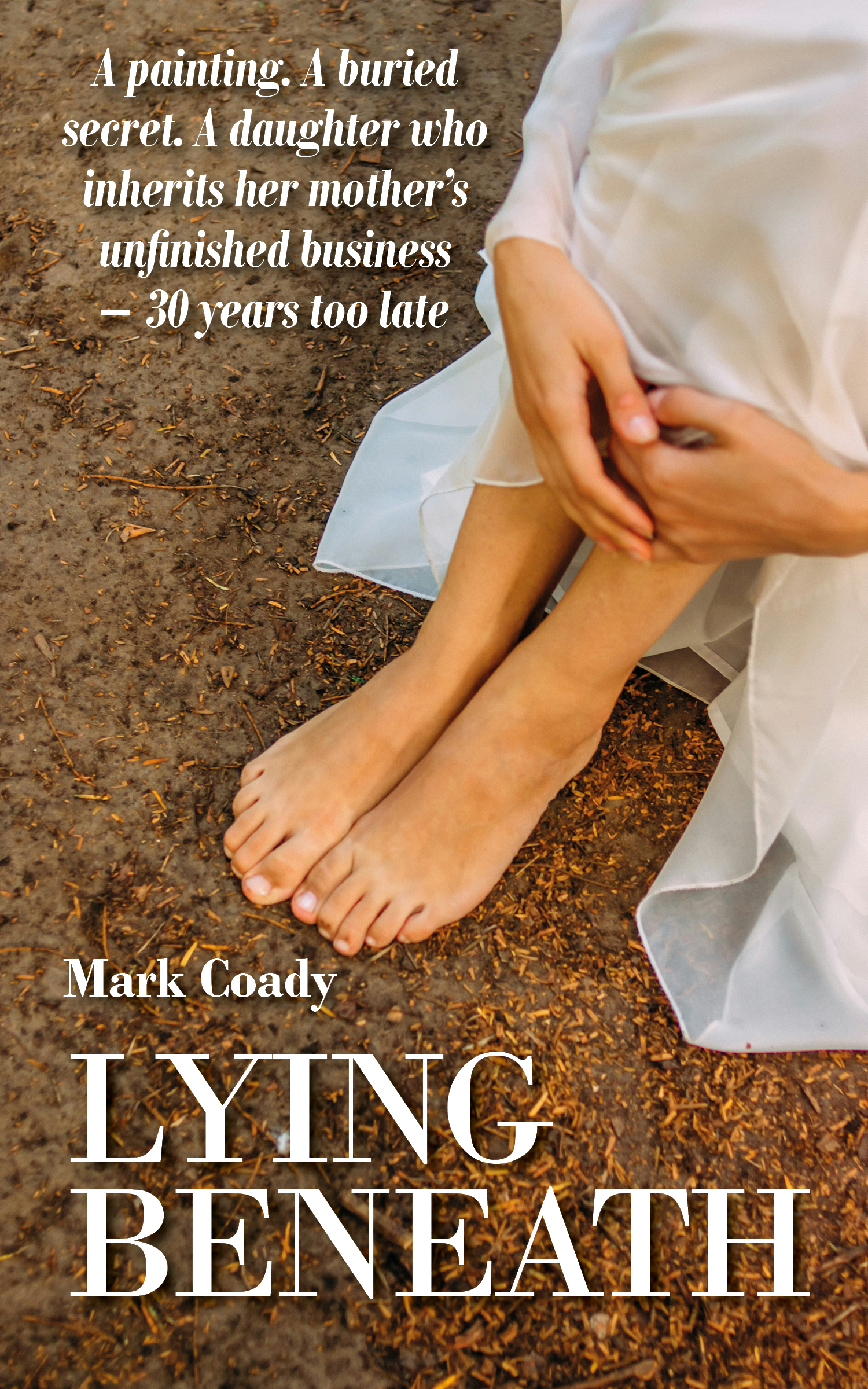
The final checks are now being made on Hickathrift’s first full-length novel, Lying Beneath by Mark Coady. It’s a 450-page blockbuster set in Northampton, London and Italy that unearths the seedier side of archaeology.
When Emma Harding arrives at a new museum in Northampton to investigate the legal status of a newly discovered Canaletto worth forty million pounds, she expects a straightforward covenant review. What she finds is rather more complicated.
 The painting depicts a valley in central Italy where her mother, archaeologist Susan Harding, worked one summer in 1994 — and never talked about properly again. The museum’s director, Jacob Ellery, was there too. Something happened that summer. Susan spent thirty years not quite saying what it was.
Moving between present-day Bloomsbury, Northampton and the heat of an Italian excavation thirty years ago, Lying Beneath is a novel about what gets buried and what endures. About the distance between the official record and the truth underneath it. About a daughter who discovers that the most important case of her career is also the one her mother never got to finish.
Part literary thriller, part excavation of memory and culpability, Lying Beneath asks what we owe to the past — and what happens when someone finally decides to go looking.
Lying Beneath is the first novel in the Emma Harding trilogy. The author is Mark Coady, from Northampton.
He says:
I’ve always been interested in what gets buried.
Not literally — though Lying Beneath does involve an archaeological dig in central Italy, and things underground that have been there for a very long time, some of them Roman and some of them rather more recent. I mean what gets buried institutionally. Professionally. In the managed language of inquiry reports and HR files and press statements that deploy careful words to describe careless acts. The way that organisations develop, over time, a remarkable facility for making inconvenient things disappear. Not dramatically. Just gradually, through the accumulation of small decisions, each individually defensible, that add up to something that isn’t defensible at all.
Emma Harding is a lawyer who has spent her career inside those organisations and has left because she can no longer stomach what they ask her to do. When she arrives in Northampton to investigate the legal status of a newly discovered Canaletto — a painting worth forty million pounds, sitting in a converted fire station that has become a museum — she expects a straightforward piece of work. Three months. Pro bono. A covenant question that nobody has properly examined for seventy years.
What she finds is that the painting depicts a valley in central Italy where her mother worked one summer thirty years ago, and that the man who runs the museum was there too, and that something happened that summer that her mother spent the rest of her life not quite talking about.
The novel moves between two timelines — present-day Bloomsbury; and Northampton, with its city status ambitions and its development corporation and its Californian investors and its very good tango class — and the summer of 1994 in Avezzano, where a team of British archaeologists is excavating a Roman site under increasingly difficult conditions. The two timelines are connected by a notebook that has been sitting in a basement in London for thirty years, unread, filed as an unidentified deposit.
Emma is not a detective. She is a woman trying to understand what happened to her mother — why a brilliant career went quiet, why a particular summer was never talked about, what the gap between the official record and the lived experience actually contained. The legal investigation gives her the professional framework. The personal investigation is what drives her.
I wanted to write about the distance between institutions and the people inside them — about how the two things can diverge so completely that by the end you can barely see one from the other. I also wanted to write about inheritance — not of money or property but of unfinished business. Of the things parents carry that children don’t know about until it’s almost too late.
And I wanted to write about Northampton, which is a town that is sixty miles by road and rail from London, and has developed, through that particular distance, its own very specific and rather wonderful character. It turns out to be an excellent place for excavation, in every sense.
Lying Beneath is the first novel in the Emma Harding trilogy. The second, What Belongs, is set partly in Leipzig and partly in Northampton, and involves a restitution claim, a possibly-Bauhaus artwork, and several more things lying beneath.
- Lying Beneath will be published on Amazon, in hardback and Kindle e-book formats in the coming days. We’ll let you know when it’s on sale.


Leave a Reply